EHX 22500 – Release Date: July 2015
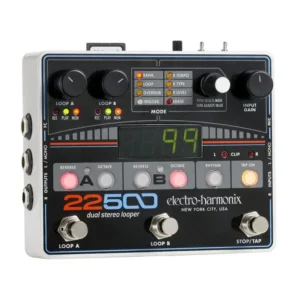
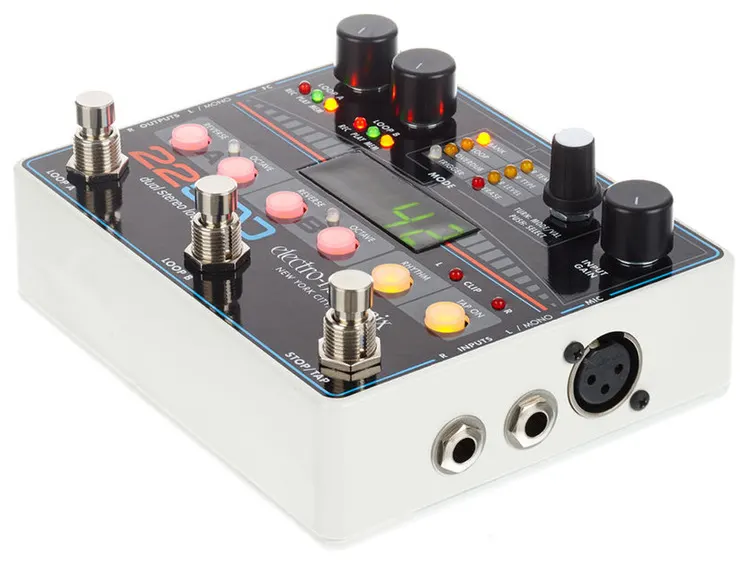
The EHX 22500 Dual Stereo Looper was an interesting pedal that, at the time it came out, was a pretty logical step up from previous looping pedals. It recorded it’s tracks to an SDHC card, that you could upgrade to a larger capacity (up to 32Gb, or keep several SD cards on hand) which would then give you far more recording capacity for your loops
The 22500 comes with an 8Gb SD card, and that is enough to allow up to approx 12 hrs of recording time, and 99 Memory locations (99 memory locations per card). A single 32 Gb SDHC card could (presumably) allow you upwards of around 48 hrs recording time. This gives any musician an immediate advantage in that you can bring with you as many SD cards as need for as many stored tracks as desired at any time. Imagine showing up at a gig with your full 637 song repertoire prepared and ready to go, just by swapping out the SD card as needed!!
A single recording on a track can be a maximum of approximately 6 hrs, which would allow you to possibly record the audio of your entire performance if you wish!! Imagine being able to easily capture the entire night’s show, and then being able to immediately supply (or sell) a copy of the night’s show to an organizer, event host, or to a grateful audience member!! Yes, you’d likely want a laptop on hand to make copies. If nothing else, you could easily be able to audit yourself … ie -listen to your own show and know if you need to adjust the mix, or a tempo, or just change your playing style.
There are a pair of 1/4″ T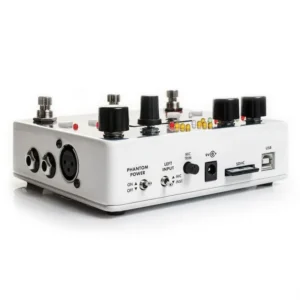 S inputs that can be used as either dual mono or stereo inputs. There is a single mic input as well. You cannot however, use the mic input as well as BOTH 1/4″ inputs. You’ll be forced to ‘give up’ the Left 1/4″ input in lieu of the mic input. There is a small toggle on the back of the 22500 that will allow you to choose between having the Mic or the 1/4″ input being active. Beside that, you’ll also find a phantom power toggle and a mic gain adjustment.
The 22500 features 2 stereo Looping channels that can be used either in sequence or in parallel (Single-Mode or Multi-Mode). A track, or just an overdub, can be played in reverse if desired. Tracks can also be played at double speed, or slowed to half speed, which can result in octave down bass lines, or octave up harmonies or leads. This gives a good musician many directions to go creatively.
Auto-Record is also available for either track, allowing you to arm the track and start recording only when you begin to play. Yet another great feature, that is not available on most loopers, is Loop Decay. You can have loops slowly fade away as they repeat, or maybe use it with Sequential mode to create a delay-like effect that has a different delay time on the second track. Now switching between the tracks allows for a very different feel to the music recorded there. There is also a one-shot mode, where the track will play thru a single time, and then stop. These are all useful capabilities, for a variety of creative soundscapes and purposes.
There are 16 built-in rhythm patterns to choose from, and you can also add your own by creating and transferring your own custom rhythms into the Looper. The computer-savy will have an easier time accomplishing this without issues, as you’ll benefit from having experience with creating folders, renaming files, file naming conventions for EHX, and editing text files with BPM, Time Signatures, and other file Meta-Data)
Be aware, changing the tempo of a rhythm pattern does change the pitch of the drums, but the tracks will try to stay at their original pitch. Extreme changes in tempo can cause some track fluttering that cannot be eradicated, except by returning the tempo closer to its original value. (This is NOT the same as the Track Speed effect)
While some loop stations may allow for ‘bridging’ two adjacent memory locations for a single and potentially very interesting performance (such as a time-signature change withing a song), the 22500 does not co-operate so easily. Any time you change to another Memory, all tracks that are playing (and the rhythm as well) will be stopped. While there may possibly be some creative work-around that you might discover and works for you, this looper will make it difficult to flip into another memory seamlessly while performing. Speaking of f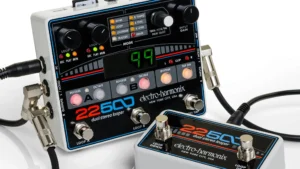 lipping thru memories, an external add-on foot switch is available that allows you to navigate up & down thru the memories instead of bending down to operate the 22500 manually. You really will benefit from this extra accessory pedal.
Sadly, there is no Midi connectivity what-so-ever in the 22500 Loop station, only USB -B and that is only for file transfers. Aside from having no Midi connectivity, the EHX 22500 is still a very interesting and capable robust loop station that is bound to give a musician plenty to explore in the looping world, especially if you were to include the add-on foot controller that is designed to compliment the package and expand your control options.
Where to Buy: